|
|
|
Citations Index
>>> |
|
Articles With Citations
to Z. Abou-Assaleh
|
|
Theoretical Plasma
Physics |
|
Controlled Thermonuclear Fusion Energy |
| |
|
1994 |
|
|
|
|
|
|
|
1994 |
| |
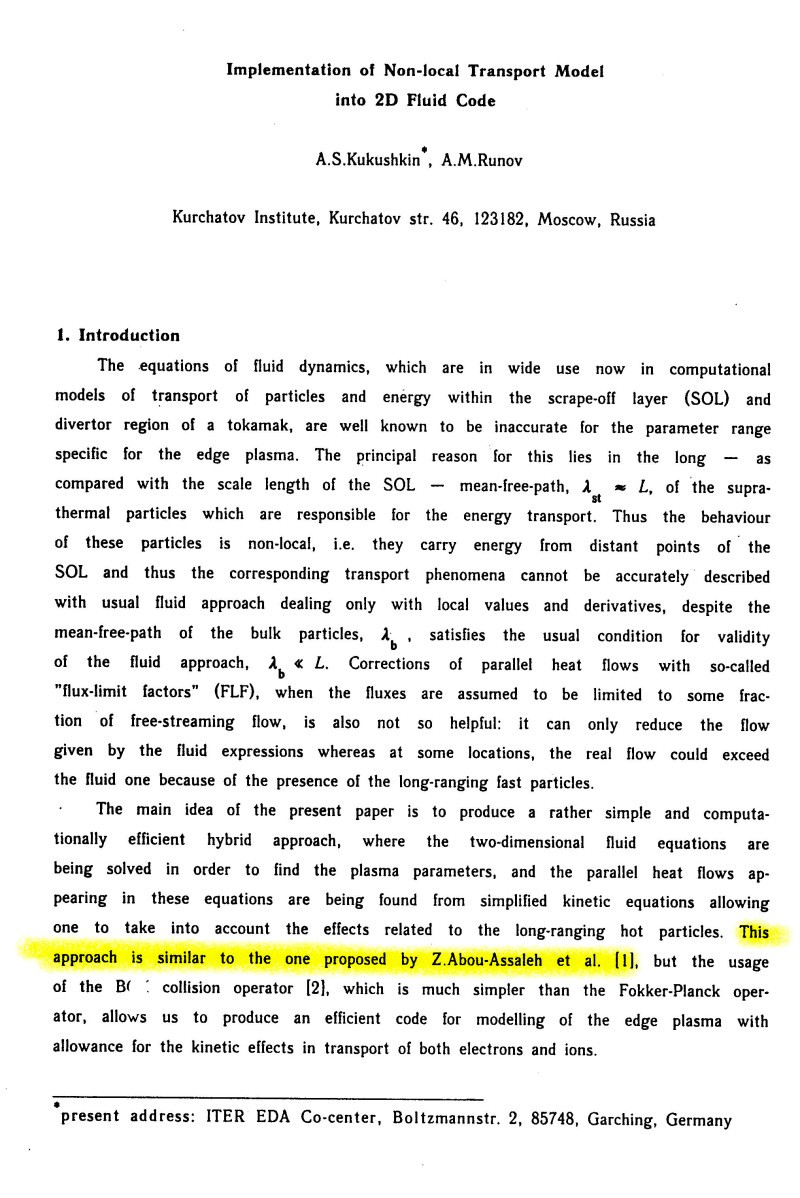
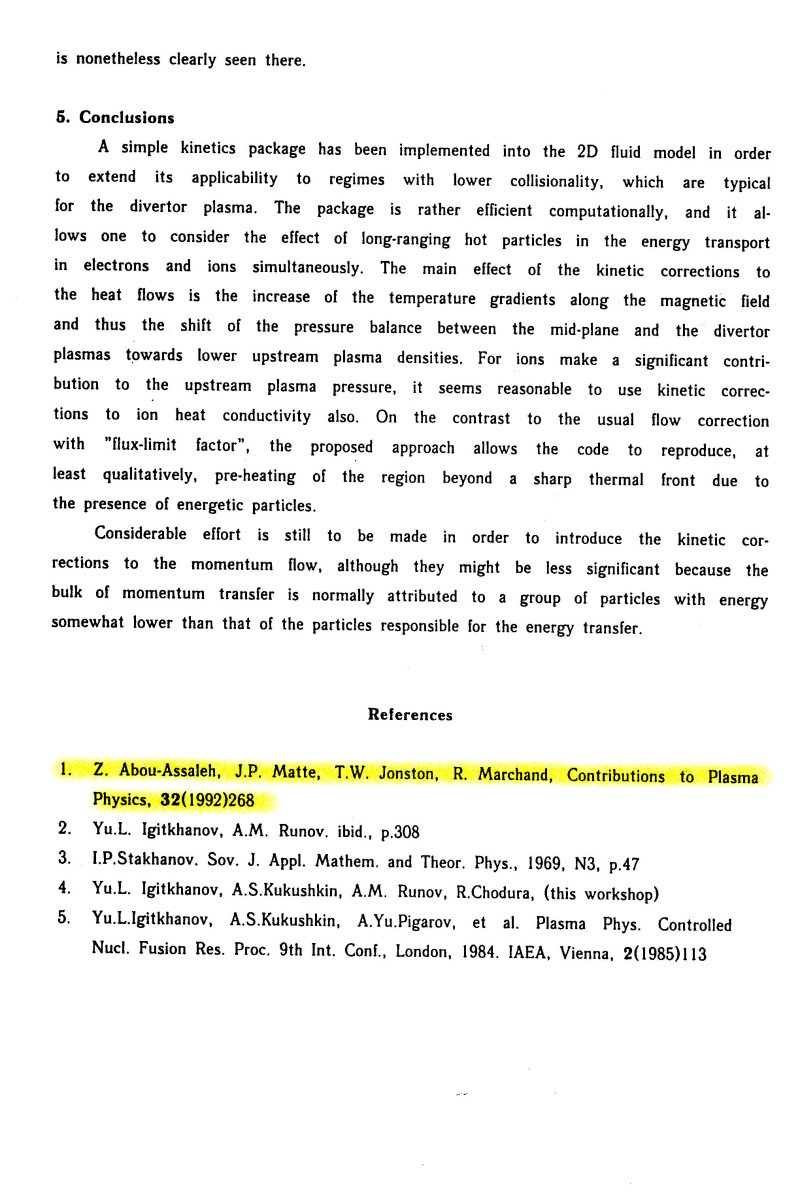
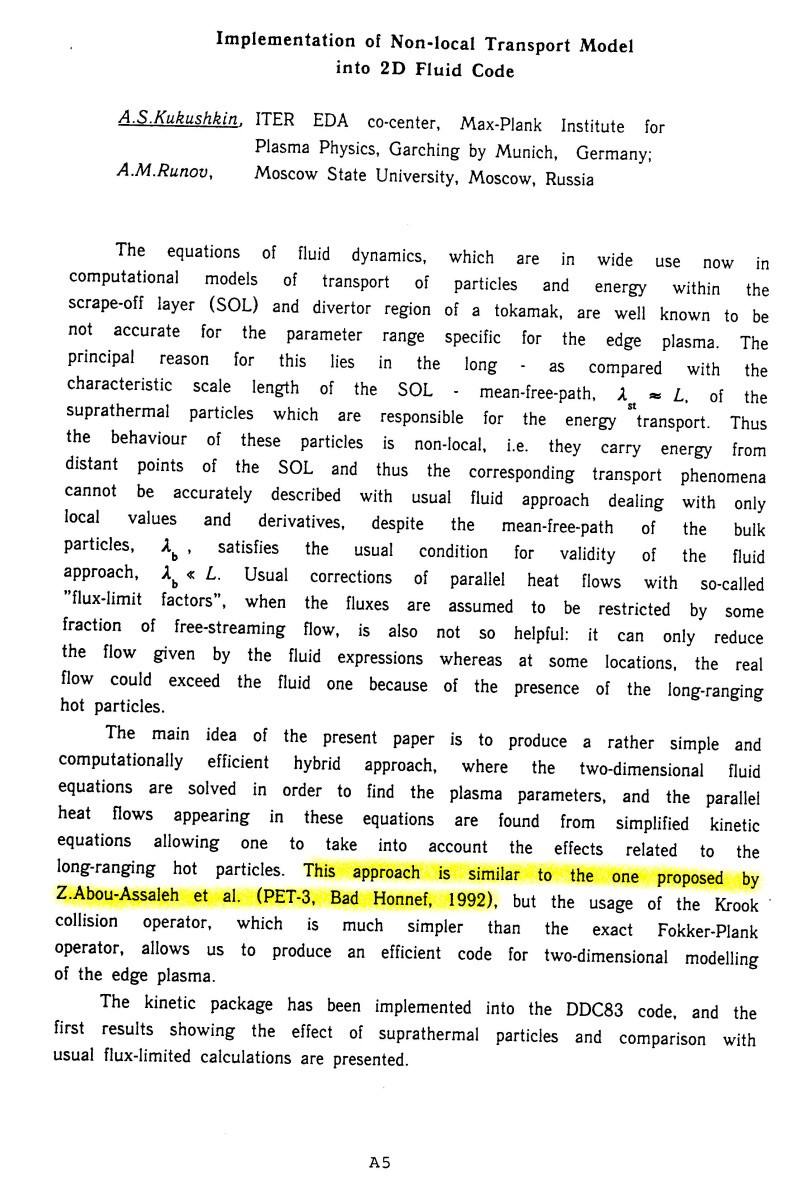
Implementation of Non-local Transport Model into 2D Fluid Code
|
A.S.Kukushkin , A.M.Runov
|
Kurchatov Institute. Kurchatov sir. 46. 123182. Moscow.
Russia
|
Contribution to Plasma Physics, 34 (1994)
|
". . .
The main idea of the
present paper is to produce a rather simple and
computationally efficient hybrid
approach, where the
two-dimensional fluid equations are
solved in order to find the
plasma parameters, and the parallel
heat flows appearing in these
equations are found from simplified
kinetic equations allowing one to
take into account the effects
related to the long-ranging hot
particles. This approach is similar
to the one proposed by Z.Abou-Assaleh
et al. (PET-3. Bad Honnef, 1992),
but the usage of the Krook collision operator,
which is much simpler
than the exact
Fokker-Plank operator, allows us to
produce an efficient code for
two-dimensional modelling of the edge plasma.
….."
|
|
|
|
|
|
|
|
1994 |
| |
https://www.osti.gov/biblio/10166537
"Absorption of intense microwaves and
ion acoustic turbulence due to heat transport"
De Groot, J S, Liu, J M, and Matte, J P.
Lawrence Livermore National Lab., CA (United States)
United States: N. p.,
1994.
Abstract
Measurements and calculations of the inverse bremsstrahlung absorption of
intense microwaves are presented. The isotropic component of the electron
distribution becomes flat-topped in agreement with detailed Fokker-Planck
calculations. The plasma heating is reduced due to the flat-topped distributions
in agreement with calculations. The calculations show that the heat flux at high
microwave powers is very large, q{sub max} {approx} 0.3 n{sub e}v{sub e}T{sub
e}. A new particle model to, calculate the heat transport inhibition due to ion
acoustic turbulence in ICF plasmas is also presented. One-dimensional PIC
calculations of ion acoustic turbulence excited due to heat transport are
presented. The 2-D PIC code is presently being used to perform calculations of
heat flux inhibition due to ion acoustic turbulence.
References
10. J.H. Rogers, J. S. De Groot,
Z. Abou-Assaleh, J. P. Matte,
T. W. Johnston, andM. D. Rosen, "Electron Heat Transport in a Steep Temperature
Gradient," Physics of Fluids B 1, 741 (1989)
|
|
|
| |
|
1994 |
|
|
|
Phys. Plasmas 1 (11), November 1994 (3570)
|
Physics of Plasmas -- November 1994 -- Volume 1, Issue 11, pp.
3570-3576
|
"Electron heat transport with non-Maxwellian
distributions"
-
J. M. Liu and
J. S. De Groot
-
Plasma Research Group, Department of Applied Science,
University of California, Davis, California 95616
-
J. P. Matte
and
T. W. Johnston
-
INRS-Énergie et Matériaux, C.P. 1020, Varennes, Québec, J3X
1S2 Canada
-
R. P. Drake
-
Plasma Physics Research Institute, Lawrence Livermore National
Laboratory, L-418, P.O. Box 808, Livermore, California 94551
(Received 8 March 1994; accepted
14 July 1994)
Abstract
Measurements
are presented of electron heat transport with non-Maxwellian (flattopped)
distributions
due to inverse bremsstrahlung absorption of intense
microwaves in the University of California at Davis
Aurora II device [Rogers et al., Phys. Fluids B 1,
741 (1989)]. The plasma is created by pulsed
discharge in a cylindrical vacuum chamber with
surface magnets arranged to create a density gradient. The
ionization fraction (~1%) is high enough that charged
particle collisions are strongly dominant in the
afterglow plasma. A short microwave pulse (~2 µs)
heats a region of the afterglow plasma (ne/ncr 0.5)
creating a steep axial (LT~1–10 0.5)
creating a steep axial (LT~1–10 ei)
temperature gradient. Langmuir probes are used to
measure the relaxation of the heat front after the
microwave pulse. Time and space resolved measurements show that
the isotropic component of the electron velocity
distribution is flat topped (~exp[–(v/vm)m],
m ei)
temperature gradient. Langmuir probes are used to
measure the relaxation of the heat front after the
microwave pulse. Time and space resolved measurements show that
the isotropic component of the electron velocity
distribution is flat topped (~exp[–(v/vm)m],
m 2)
in agreement with Fokker–Planck calculations using the
measured density profile. Classical heat transport theory
is not valid both because the isotropic component of
the electron velocity distribution is flattopped and
the temperature gradients are very steep. Physics of Plasmas is
copyrighted by The American Institute of Physics. 2)
in agreement with Fokker–Planck calculations using the
measured density profile. Classical heat transport theory
is not valid both because the isotropic component of
the electron velocity distribution is flattopped and
the temperature gradients are very steep. Physics of Plasmas is
copyrighted by The American Institute of Physics.
|
|
Electron heat transport with non-Maxwellian
distributions
|
|
Electron heat transport with non-Maxwellian
distributions
|
|
|
|
1994 |
| |
Phys. Rev. Lett. 73, 2055–2058 (1994)
|
"Measurements of Radial Heat Wave Propagation
in Laser-Produced Exploding-Foil Plasmas"
- D. S. Montgomery1,
O. L. Landen1,3, R. P. Drake2,3, K. G.
Estabrook1, H. A. Baldis1, S. H. Batha2,
K. S. Bradley3, and R. J. Procassini1
-
1Lawrence Livermore
National Laboratory, Livermore, California 94551
-
2Plasma Physics
Research Institute, University of California Davis and
Lawrence Livermore National Laboratory, Livermore, California
94551
-
3Department of
Applied Science, University of California Davis, Davis,
California 95616
Abstract
Time-resolved, 2D images of
x-ray emission from thin, laser-irradiated titanium foils are
presented. The foils are irradiated with 0.35 µm light at
intensities of 1
x 1015 W/cm2 which produces a
plasma with electron densities <= 1022 cm-3
and electron temperature of 3-4 keV. X-ray emission that is
characteristic of the thermal heat front is observed to
propagate radially outward from the heated region. Comparison of
these measurements with 2D hydrodynamic simulations of the
experiment suggests the radial heat flux to be about 3% of the
free-streaming heat flux.
©1994 The American Physical
Society
URL:
http://link.aps.org/abstract/PRL/v73/p2055
|
|
Phys. Rev. Lett. 73, 2055 (1994) Montgomery
et al. - Measurements of Radial Heat...
|
|
Measurements of radial heat wave
propagation in laser-produced exploding-foil plasmas
|
| |
| |
|
1994 |
|
|
Phys. Rev. A 50, 2691–2700 (1994)
|
"Electron distribution function in a thin
plasma layer and possible x-ray laser emission due to a sharp
temperature gradient"
- Boris N. Chichkov, Yoshiaki
Kato, Hartmut Ruhl, and Sergey A. Uryupin
-
Theoretical Quantum
Electronics, Technical University Darmstadt, Hochschulstrasse
4A, Darmstadt, Germany
-
Institute of Laser Engineering,
Osaka University, 2-6 Yamada-oka, Suita, Osaka 565, Japan
-
P. N. Lebedev Physics
Institute, Leninsky prospect 53, Moscow, Russia
Abstract
The temporal evolutions of the
electron distribution function and the electric field in a
dense, hot, multiply charged plasma due to the presence of a
sharp temperature gradient from one side (plasma–cold matter
contact) and a sharp density gradient from the other side
(plasma-vacuum boundary) are studied. The prospects for x-ray
lasing in such a plasma are discussed. The analogy with a p-n
junction semiconductor laser is emphasized.
©1994 The American Physical
Society
URL:
http://link.aps.org/abstract/PRA/v50/p2691
|
|
Phys. Rev. A 50, 2691 (1994)
Chichkov et al. -
|
|
https://journals.aps.org/pra/abstract/10.1103/PhysRevA.50.2691 |
| |
|
1994 |
|
|
Phys. Rev. Lett. 72, 2717–2720 (1994)
|
"Measurements of inverse bremsstrahlung
absorption and non-Maxwellian electron velocity distributions"
- J. M. Liu, J. S. De Groot,
J. P. Matte, T. W. Johnston, and R. P. Drake
-
Plasma Research Group,
Department of Applied Science, University of California,
Davis, California 95616
-
Institut National de la
Recherche Scientifique Energie et Matériaux, C.P. 1020,
Varennes, Québec, Canada J3X 1S2
-
Plasma Physics Research
Institute, Lawrence Livermore National Laboratory, L-418,
P.O. Box 808, Livermore, California 94551
Abstract
Non-Maxwellian (flattopped)
electron velocity distributions resulting from inverse
bremsstrahlung of intense microwaves are measured directly for
the first time in experiments performed on the UCD AURORA II
device. The experiments are performed in the afterglow of a
pulsed discharge plasma that is moderately collisional and
sufficiently ionized (~1%) that Coulomb collisions are
dominant. Langmuir probe measurements indicate that the
isotropic component of the electron velocity distribution is
non-Maxwellian in very good agreement with electron kinetic
(Fokker-Planck) simulations.
©1994 The American Physical
Society
URL: http://link.aps.org/abstract/PRL/v72/p2717
DOI: 10.1103/PhysRevLett.72.2717
PACS: 52.50.Gj, 52.25.-b, 52.50.Jm, 52.65.+z
|
| |
|
Phys. Rev. Lett. 72, 2717 (1994) Liu et al.
- Measurements of inverse bremsstrahlung...
|
|
Measurements of inverse bremsstrahlung
absorption and non-Maxwellian electron velocity distributions
|
|
"Measurements
of inverse bremsstrahlung absorption and non-axwellian electron velocity
distributions"
|
| |
| |
|
|
|
Citations Index
>>> |
| |
|